

🌎📡 [ begin transmission ] :
Dear past,
My daughter broke her wrist last spring.
She fell out of a tree in the park and landed wrong, the way kids do. We took her to the clinic down the street. They asked her name, where it hurt, and what happened.
That was all they asked.
That night, while I was helping her into bed with the cast still fresh, I remembered something I’d read about your time. Families used to ask what an injury would cost before they asked how bad it was. Some people waited out a fever because they were scared of the bill. Some lost their doctor the same week they lost their job.
I thought about that for a long time while she slept.
It’s strange what becomes normal once enough time passes.
We haven’t solved being human. People here still get sick and lose jobs and lose each other. We still argue about what’s fair. But there are a few questions we finally stopped asking.
We stopped asking whether a sick person deserved care. We stopped asking whether a child should eat based on choices their parents made. When someone here falls on hard times, nobody leaves them outside to prove they deserve to come back in.
There are still people with more than others. Some of them have a lot more. But somewhere along the way, we stopped believing that someone had to be desperate so someone else could be powerful.
The world did not become equal.
It became less cruel.
My grandfather was the last person in our family to fight in a war.
When I was little, he’d tell me about the people he met overseas. Mostly he talked about the boy who sold fruit near the base, and the family who let soldiers drink from their well. And about a man not much older than him, who was supposed to be his enemy, and who looked, he said, mostly afraid.
That one stayed with me.
Countries still disagree here. People still find reasons to hate each other. Borders still exist, and people still love the places they come from. But war is rare now. Most arguments between countries end in long, boring rooms full of translators and bad coffee. I think that boredom is one of our greatest achievements.
I think it happened because people slowly became harder to convince.
Harder to convince that a ruined city was a victory.
Harder to convince that a dead child belonged to the correct side.
Harder to convince that twenty years of violence would finally produce the peace that twenty years of violence never had.
My cousin still serves. She trains harder than anyone I know, and she’s ready for anything. Last year her unit spent four months on the other side of the ocean, rebuilding a town after a flood, alongside engineers from countries we used to call enemies. The family whose house they rebuilt let them drink from their well.
We never lost our appetite for difficult things. We found better things to do with it.
There was no single treaty and no date I can point to. Most change arrives like daylight, slow enough that the people living through it barely notice the room getting brighter.
Energy went the same way.
Our museums have old photographs of cities under brown haze, and kids look at them the way you looked at pictures of steam engines. We use more energy than you ever did. We just learned to draw it from what was already there: the sun, the wind, the atom.
For years people argued about whether the future was possible while engineers quietly built it. Then one year the future became cheaper than the past, and most of the argument went away.
There’s a river near my house that runs clean because somebody, a long time ago, stood up in a meeting room and refused to accept that poisoned water was the price of a paycheck. I don’t know their name. You probably never knew it either.
But I live inside what they did.
On Saturdays, my daughter and I take the train into town. It’s runs every few minutes, but people still complain. People here complain constantly, by the way. You’d probably find that comforting.
Old men argue about sports. A kid across from us reads with her feet up on the seat. Downtown is built for walking: a library with the doors propped open, a café where the same people sit at the same tables, the park with the tree she fell out of. The hall on the corner hosts union meetings on Tuesdays, chess club on Thursdays, and a dance on Fridays that nobody under fifty takes seriously.
Her school is a few blocks down. The classes are small, and her teachers know what she’s curious about before she does. She still hates math.
We still have news, and scandals, and elections, and plenty to argue about. We just stopped building whole industries around keeping people frightened enough to keep watching.
I read once that people in your time could live surrounded by millions of others and still feel completely alone. Here, fear got harder to sell once fewer people were living one emergency away from losing everything. It didn’t disappear. Nothing that human seems to. But it’s harder to convince someone their neighbor is the enemy when they actually know their neighbor’s name.
When people stopped being afraid of falling, they started making things: music, furniture, gardens, research, and a lot of terrible poetry.
Recently I found a box of letters and essays from your era. A lot of them were written in the years when the world was still learning what it meant to live online.
I expected you to sound distant.
You sounded like us.
You worried about your kids. You were tired of war. You wondered why someone could work every single day and still be one emergency away from losing everything. You worried that money was getting too loud and people were getting too quiet.
And the part that surprised me most was simple.
You knew.
You knew people shouldn’t die because they were poor. You knew a child shouldn’t go to bed hungry in a country that threw food away. You knew the people on the other side of a border were people.
You knew.
So for a while, I couldn’t understand why it took so long.
Honestly, I understand it better now. Some people were afraid. Some were too busy surviving to think about changing anything. Some had been disappointed so many times that cynicism felt safer than hope. People made terrible arguments for good causes and good arguments for terrible ones. Progress was messy. It usually is.
Human nature didn’t change much between your time and mine. The conditions did. We built a world that brings out more of what was already good in people.
And I have a confession. If I had lived in your time, I’m not sure I would have been one of the dreamers. I might have been one of the people calling them unrealistic.
Because we do it too. There are arguments in my world I’m certain will embarrass us someday. There are people telling us something is wrong, and a lot of us are telling them they’re asking for too much.
We call them unrealistic.
You probably recognize that word.
Every age has its impossibilities.
Until it doesn’t.
There was a time when walking on the Moon sounded like fantasy. There was a time when a weekend off work was an unreasonable demand. History has a habit of turning impossible things into ordinary things, but only after somebody is foolish enough to imagine them first.
That’s why I’m writing to you.
I can’t promise that everything you’re hoping for happens. Some things take longer than you’d think. Some progress slides backward, and the next generation has to climb it again. There’s no finish line, only inheritance. You inherited a world from people who never met you, and I inherited one built partly by you.
That changed how I think about hope.
Hope is looking directly at the world as it is and refusing to believe this is the best human beings can do.
None of this happened because everyone finally agreed. People argued their way through all of it. But eventually enough of them understood that we were sharing the same world, whether we liked each other or not.
So when someone tells you a more peaceful world is unrealistic, or that politics can never really change, remember that you can’t see the whole morning from where you’re standing. Neither could the people before you. Neither can I.
All any of us can do is let in a little more light than we found.
Somebody will wake up in a brighter room because you did.
My daughter is asleep upstairs now. Her wrist is healing.
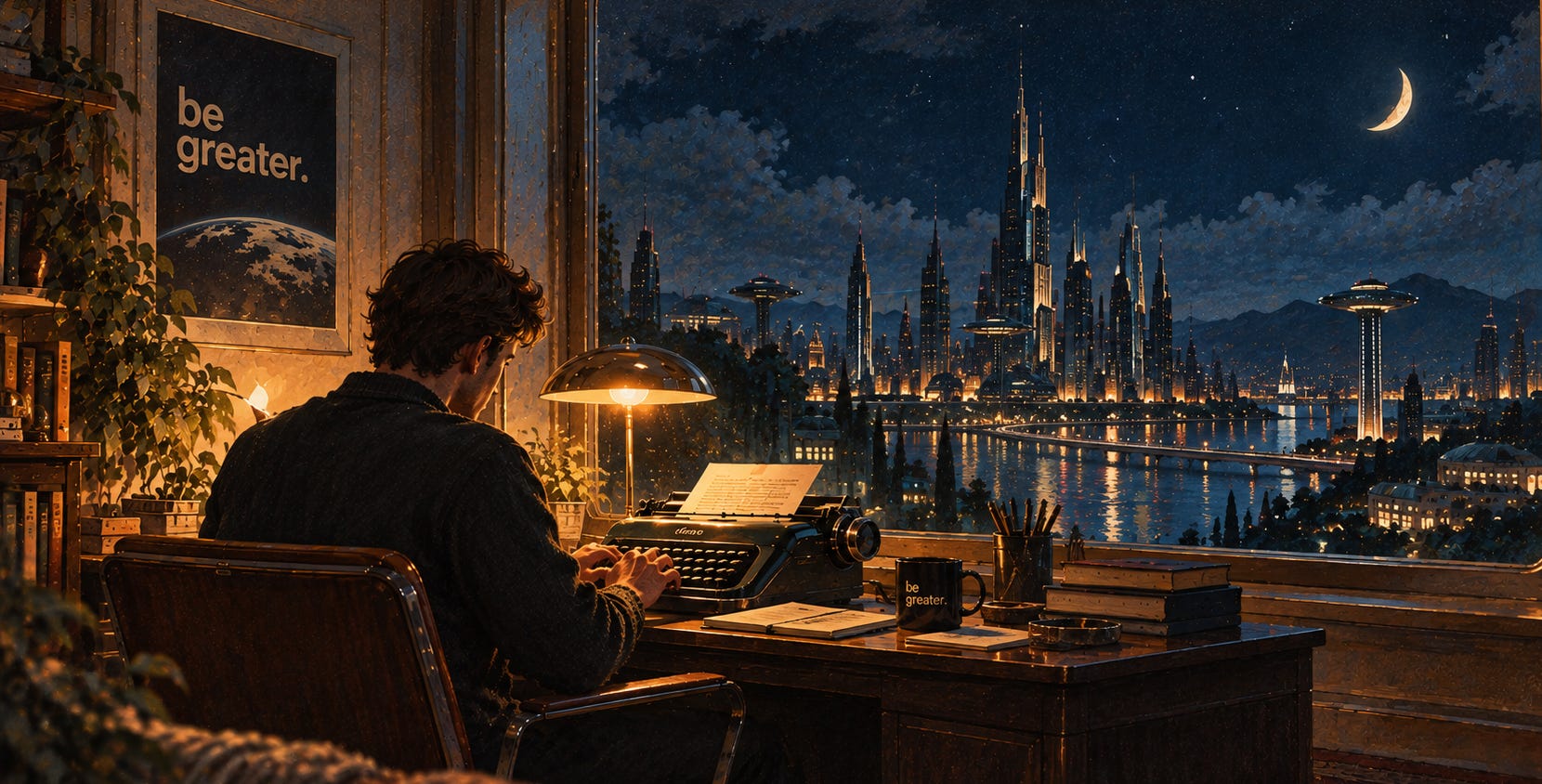
She has no idea that getting hurt used to come with a price tag. Someday she’ll learn about your world, and she’ll ask me why it stayed that way for so long. I’ll try to explain.
But I’ll tell her something else too.
There were people back then who could already see us. People who imagined this before it existed. I don’t know their names. Maybe history never will.
So if you’re wondering whether it’s worth dreaming about a world you might never get to see,
it is.
I’m living in it.
With gratitude,
The greater world of tomorrow
[ end transmission ] .