

When one person remembers the plot.
Bringing competition back to the NBA All-Star Game, reading books, and doing your own thing.
![[garrett fowler]'s avatar](https://substackcdn.com/image/fetch/$s_!WxZk!,w_108,h_108,c_fill,f_webp,q_auto:good,fl_progressive:steep/https%3A%2F%2Fsubstack-post-media.s3.amazonaws.com%2Fpublic%2Fimages%2F6ce97a08-7520-465c-b0bd-955824c2756d_640x640.png)
🌎📡
welcome :)
You’re reading Be Greater. — A publication from the last offline generation.
*a newsletter for those who want to explore what it means to raise our standards and live better in order to be greater in the modern world.
thanks for tuning in.
NBA All-Star Weekend is supposed to be the celebration of the best basketball players on the planet.
The best players of the East against the best of the West. Or in 2025, the best of America against the best of the World. Either way — The most talented players alive, all on the same floor at the same time, competing for something most players will never even get a chance to compete for.
On paper, it should be electric.
But for a while, it wasn’t.
Somewhere along the way, the NBA All-Star Game quietly became something else. Not a competition — a showcase. Players lobbing half-court shots, laughing on defense, throwing up trick passes that didn’t need to go anywhere because nothing was actually at stake. Flashy for the sake of flashy. Fun in a way that felt hollow. The best players in the world treating the biggest stage of the weekend like a pickup game at a gym that nobody really cared about.
The reasoning behind this trend made sense, technically. The ultimate goal of an NBA season is the Final Championship. One bad landing, one twisted ankle in a game that doesn’t count towards the finals, and your whole season changes. The risk-reward calculation is real and players know it.
But something was still being lost. The spirit of it. The standard of it. The idea that when you’re one of the best in the world and you’ve been given a stage, you show up fully and you give the fans something real.
That standard had been quietly lowering for years.
Then a 7-foot French kid walked into the locker room carrying a book.
Pre-game Literature
It’s February 2025. San Francisco. Victor Wembanyama is making his All-Star debut — coming off a unanimous Rookie of the Year season, already looking like something the sport hasn’t quite seen before.
And he brought a book with him.
Not a flashy watch. Not a new car to show off in the parking lot. A book. Under his arm. In the locker room before the biggest exhibition game of the year.
Nikola Jokic — three-time MVP, one of the greatest players alive — walked over and looked at him.
“You really brought a book?”
“Yeah! I read before every game,” Wembanyama said.
Jokic kind of scoffed and put his face in his hands. The whole exchange had the energy of someone watching a kid do something slightly bizarre — endearing but puzzling. Like, here? Now? At All-Star Weekend?
Yes. Here. Now. At All-Star Weekend.
Because that’s who he is. Not a performance of who he is. Not a curated image of focus and discipline that he switches on for the cameras. He reads before every game — regular season, playoffs, All-Star, it doesn’t matter. The routine doesn’t change based on whether people are watching or whether the occasion seems to call for it.
LeBron James, when asked about Wembanyama around this time, said he’d heard that nobody better call him past 9 o’clock at night because he’s either reading or he’s asleep.
“That lets you know where his mind is,” LeBron said. “That’s super cool. That’s super dope.”
It is. But it’s also more than cool. It’s a standard. A quiet, private, completely consistent standard that doesn’t bend for the moment.
Play Like You Mean It
Here’s the part that makes the story complete.
Wembanyama didn’t just bring his book and then coast through the game like everyone else. He showed up and actually played. He was dunking on people. Chasing down shots to block. Hustling. Competing. Visibly frustrated when his team lost the final.
He actually tried hard. At the All-Star Game. Even when the culture of the event had spent years slowly normalizing not trying.
Earlier that weekend he’d gotten himself and Chris Paul disqualified from the skills competition after finding what he thought was a loophole in the rules — because even in a side event on a Friday night, he was looking for an edge. Trying to win. Not because anyone expected him to, but because that’s apparently just how he’s wired.
Think about what that combination looks like from the outside. He slows down before the game. He reads. He’s in no rush. And then when it’s time to play, he plays like it means something. The stillness and the intensity aren’t opposites — they’re connected. The reading isn’t a quirk, it’s preparation. The same discipline showing up in two different forms.
He wasn’t doing it for the reaction. He wasn’t performing focus for a brand deal or a highlight package. Jokic laughed at him and he didn’t flinch. He just kept doing what he always does.
That’s the part worth paying attention to.
A Greater Influence
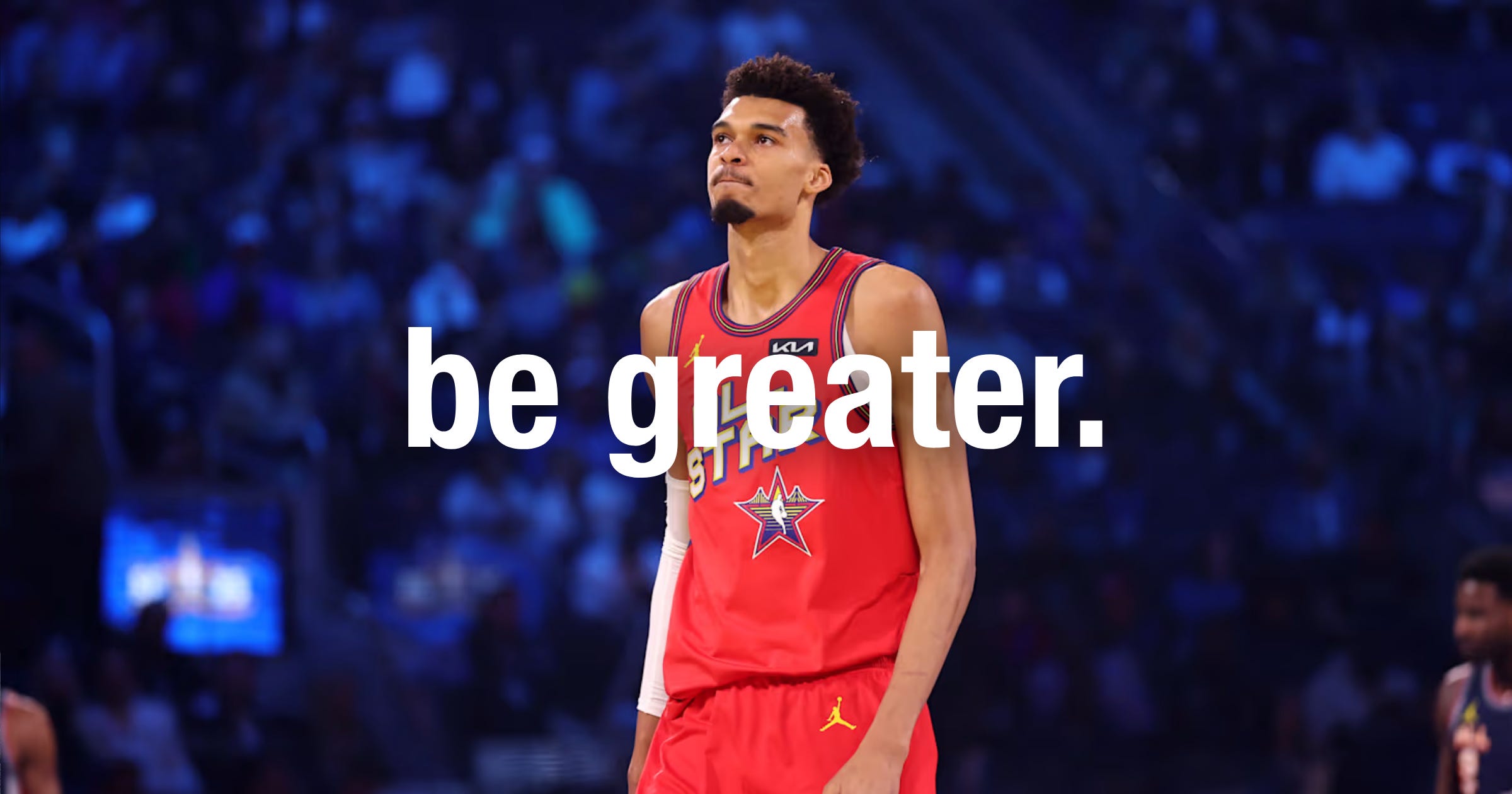
The 2026 All-Star Game arrived and Wembanyama showed up just like before. Same energy. Same standard. No special adjustment for the occasion.
Before the game, fellow All-Star Anthony Edwards was asked if the intensity could match the Olympics. He said flatly: No. Several stars were limited by injuries. The expectation, from the players themselves, was more of the same.
Then Wembanyama came out and scored the World Team’s first seven points right out of the gate. Playing defense like it was Game 7. Visibly frustrated when his team gave up an open three on the final play. Storming back to the bench the same way he would after a regular season loss.
And the vibe of the game shifted too.
After the game Edwards said: “I ain’t gonna lie, Wemby set the tone. He came out playing hard, so it’s hard not to match that. It woke me up for sure.” That’s the MVP of the game — a 24-year-old who’d said the night before that he wasn’t going to try — crediting one player for changing the entire energy of the evening.
The veterans felt it too. Kawhi Leonard dropped 31 points in 12 minutes. LeBron was sprinting the floor. De’Aaron Fox hit a buzzer-beater to win a game. All three opening games went down to the wire. The NBA registered its highest All-Star audience since 2011.
Before the game Wembanyama had said simply: “It’s the game I personally cherish. Being competitive is the least I can do.” And if they didn’t match his energy, he said, he’d bring it alone.
And he did. Which caused other players to follow his lead and step up to match the level of competition.
Not because of a rule change or a marketing campaign or a pregame speech from a legend. Because one player refused to lower his standard, and everyone else eventually rose to meet it.
That’s not a small thing, it’s the whole point.
When One Person Decides to Try
The All-Star Game had a problem that nobody could fix with format tweaks or rule changes. The problem was never the structure. It was the standard.
When the standard is that nobody really tries, that’s just what the game becomes. Everyone looks around, registers that this is how it’s done, and matches the energy in the room. It’s social. It’s human. We calibrate to the people around us almost without realizing it.
But that also means it only takes one person to break the spell.
One player deciding to actually compete changes what’s possible. The younger players feel the pull to match it — to prove they belong. The veterans feel it too, that instinct to show they’ve still got it. Suddenly there’s something to push against. Suddenly the game has stakes again, even informal ones.
One person raises the standard and the room recalibrates.
Wembanyama didn’t fix the All-Star Game overnight. But across two years, he brought something real into a space that had been running low on it. And that matters more than any final score.
Why This Stuck With Me
I’m a NBA fan from North Carolina who doesn’t follow the Spurs, doesn’t have a particular history with French basketball, and had no specific reason to care about Victor Wembanyama before that weekend in 2025.
But when I saw a 21-year-old show up to the most performative event of the basketball calendar with a book under his arm, do his routine exactly the way he always does it, laugh off the skepticism, and then go out and actually play — I became a fan instantly.
Not because of the athleticism, though it was extraordinary, but because of what these actions say about who he is when nobody’s requiring him to be anything in particular. What he decides to do without being told to, or required to, or even copying someone else. He’s just doing it because he feels like it’s the right thing to do.
He didn’t need the All-Star Game to feel important in order to show up fully. He brought his standard with him and applied it to whatever situation he was in. The situation didn’t set the standard. He did.
That’s rare. And it’s getting rarer.
We live in a culture that is very good at performing effort and very selective about actually applying it. We post about discipline. We quote people about hard work. We consume content about high standards while the actual standard of how we spend our days quietly drifts toward convenience, toward whatever requires the least resistance, toward matching the energy of the room even when the room isn’t trying.
Wembanyama didn’t do that. At 21, in his first All-Star Game, surrounded by the best players on earth at an event that had basically institutionalized coasting, he just did what he always does.
He read the book. He played the game. He tried to win.
The Standard
You’re not playing in the NBA All-Star Game. Neither am I.
But the question Wembanyama is quietly asking applies to everyone.
Do you bring your standard to the situation, or do you let the situation set your standard for you? Do you show up fully to the things that don’t require you to? Do you do your preparation even when nobody’s checking? Do you try in the rooms where the culture is to not try — or do you just match the energy and tell yourself it’s fine because everyone else is doing the same?
The book in the locker room wasn’t about basketball, it was about being the kind of person who has a standard and keeps it regardless of the occasion. Who doesn’t save their best self for the moments that feel important enough to deserve it — but brings that self everywhere, quietly, consistently, without needing applause for it.
And it turns out that when you do that — when you just keep your standard even when nobody else is — sometimes the whole room wakes up.
That’s what it means to be greater.
Not louder. Not flashier. Just more consistent. More intentional. And without compromise.
Log off, spread love, be greater.
— [gf]