

🌎📡 [ begin transmission ] :
Welcome :) You’re reading Be Greater. Thanks for tuning in.
I recently learned a visualization technique that changed the way I handle my own mind.
It’s called “Leaves on a Stream.”
If you’ve done any mindfulness work before, you might have already heard of it. I never had. But when I first tried it, something clicked that years of “just empty your mind” never did.
Here’s how it works:
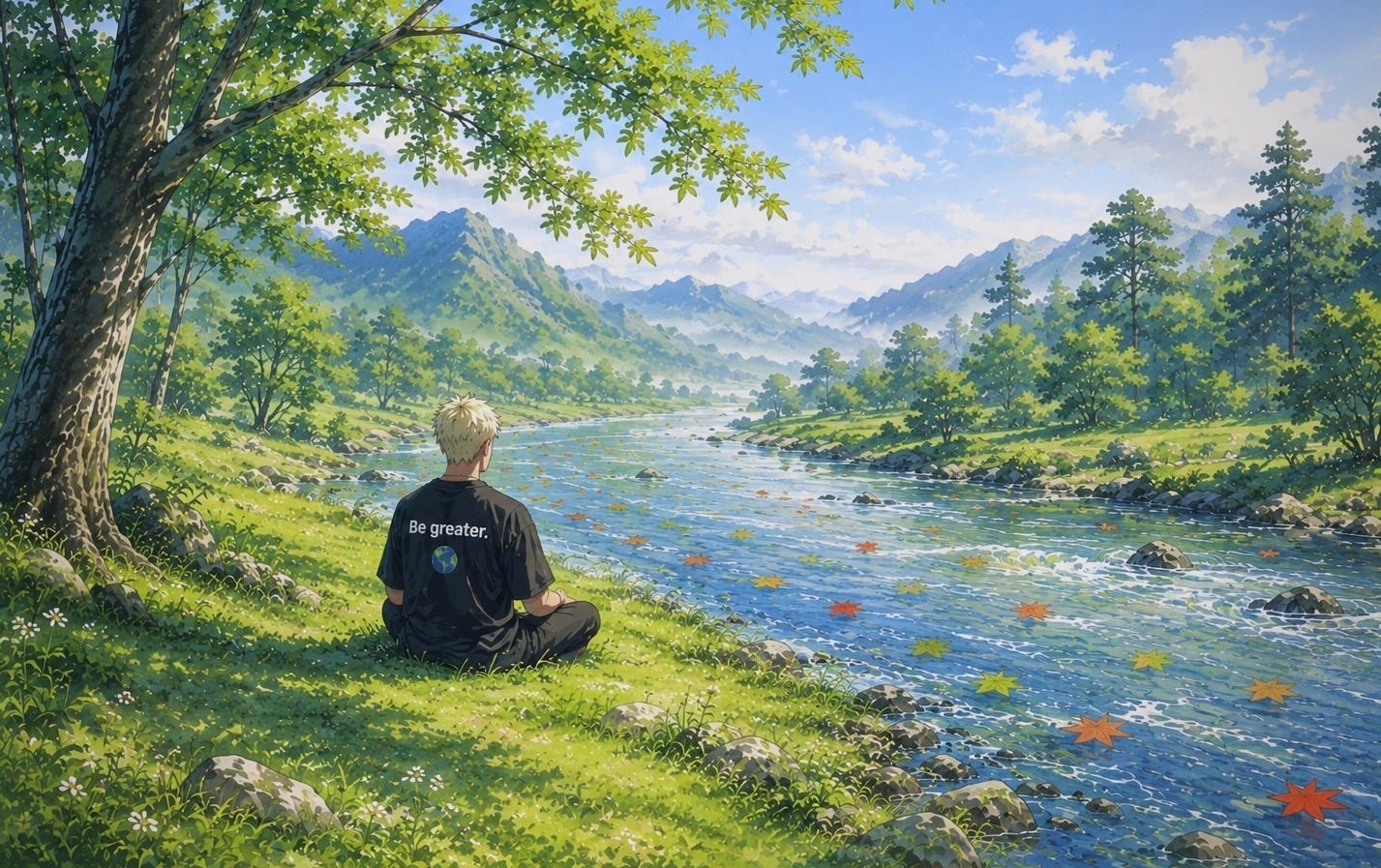
Imagine you’re sitting on a soft patch of grass beside a gentle stream. The water is flowing steadily by.
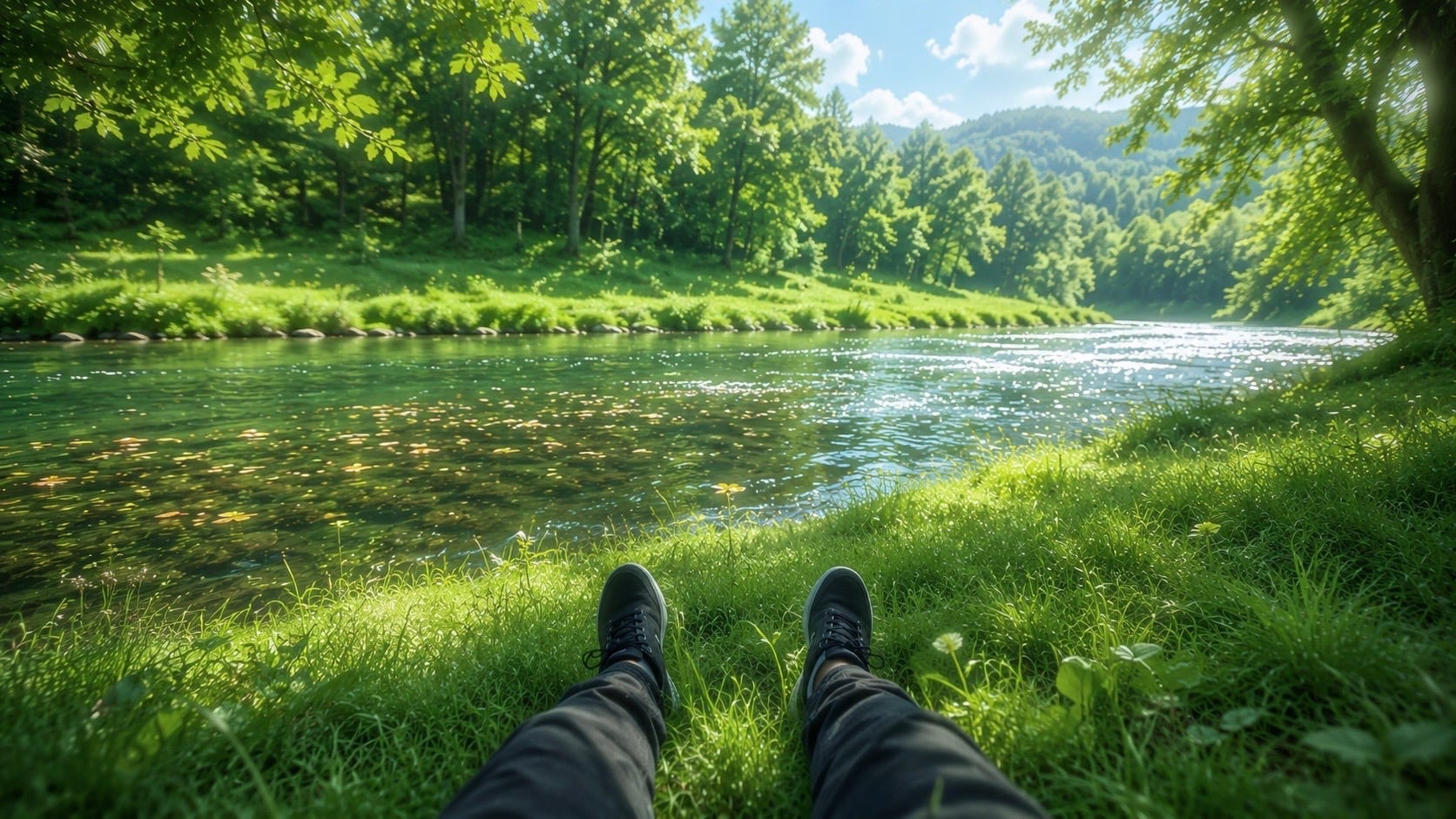
Leaves are floating down the surface, drifting past you one by one.
Your mind is the stream.
Your thoughts — feelings, memories, impulses, worries — those are the leaves floating by. 🍂🍃
When a leaf appears, you don’t fight it and you don’t chase it. You don’t focus too hard on it and you don’t try to ignore it. You just notice it, and let it float on down the river.
If a leaf gets stuck on you, gently pick it up and place it back in the stream. Watch it drift until it disappears around the bend.
Another leaf comes. Simply observe it, label or identify it, and let it float away. After every leaf, return back to the present moment.
Chilling on the riverbank. Breathing fresh air. You’re fine. Happy to be alive and grateful to be here in this moment.
The whole point is: you are not the leaves, and the leaves are not you. They don’t control you. You can observe them, label them, and let the negative ones float past while keeping the good ones. The system is designed around separation. The stream flows. The leaves drift. You sit calmly on the side.
*The versions of this that I found online are slightly different from the way I practice it.
The typical exercise says you’re sitting by the stream, and there are already leaves floating in the water. When you have a thought, you mentally pick up that thought and place it on top of a leaf. The leaf carries it away.
Thoughts and leaves are separate in the original.
That version still works great. If it clicks better for you, then use it.
But in my version, the thoughts ARE the leaves. The stream IS your consciousness and the leaves on the surface are your thoughts in physical form. The separation is immediate by design — the natural order of this space is leaves floating downstream while you sit calmly on the bank. It’s less natural for a leaf to fly out of the water and latch onto you. Every time you reset, the leaves are already separate from you again. I find it easier to label them and let them go this way.
Try both. Pick whichever one gives you the cleanest separation from your thoughts. That’s the whole point.
The technique comes from Acceptance and Commitment Therapy, developed by psychologist Steven Hayes in the 1980s and formally introduced to the clinical world in 1999.
It’s designed to teach cognitive defusion — separating yourself from your thoughts so you can observe them without being controlled by them.
The insight is simple: you are not your thoughts. You are the one watching them.
I’ve been doing this for a few weeks, and it’s genuinely changed how I relate to my own mind.
Now I catch myself doing it automatically throughout the day.
It works best when it’s focused and intentional — like in seated meditation. But one of the whole points of mastering that state is to learn how to apply it in our daily lives. Using it whenever you need to be calm and think clearly. Or just using it to be more present, which is just a fancy way of saying living your life more fully.
Because what I’m really doing is building a metaphysical space inside my own mind. A quiet haven that exists in the present moment. The grassy bank. The stream. The leaves. It’s always there, waiting for me to return to it.
Anytime my mind is racing. Anytime I’m stressed or spiraling about something I can’t control. I take a deep breath, and I return to the bank. I watch the leaves flow past. I don’t let them drag me down with them.
Every time I return, I’m strengthening the muscle of presence.
Learning to identify thoughts and emotions instead of being consumed by them. Training myself to respond instead of react.
And here’s the best part: you get to choose what to do with your thoughts. You don’t have to follow every leaf downstream. You can still follow the good feelings, the warm energy, the thoughts worth keeping. You just don’t have to be dragged under by the bad ones. You can let those float past without giving them power over you.
The modern world makes this harder than it used to be.
Our minds are noisier than ever. Notifications. Headlines. Algorithms. The constant drip of other people’s opinions and crises.
Your phone is a thought-generating machine. It fills your stream with leaves that aren’t even yours.
Many of us walk around reacting to everything. A negative comment sends us spiraling. A bad headline ruins the morning. The mind races from one worry to the next without ever stopping to ask whether any of it is real or useful or even ours.
That’s the lower standard — letting the stream drag you wherever it wants.
The higher standard is sitting calmly on the bank, watching the leaves, and waiting for the right ones to act on.
This isn’t about becoming numb or pretending everything is fine when something needs fixing.
It’s about agency. Choosing which thoughts get your attention and which ones get to float past. Realizing you don’t have to attend every argument your mind invites you to.
You can just sit on the grass and chill. Breathe. Feel the air. Watch the leaves go by.
So sit down. Close your eyes. Find the stream.
Create that calm space by the water. Watch your leaves (thoughts) float into view.
Then calmly observe them, and let them float by. If any start getting stuck on you, just gently pick them up, place them back in the stream, and let them go.
Whenever you’re feeling negative, or anytime you remember to, return to that space and check in with yourself. As many times as you need to. Until it becomes natural.
Log off, spread love, be greater.
– [gf]
[ end transmission ] .