


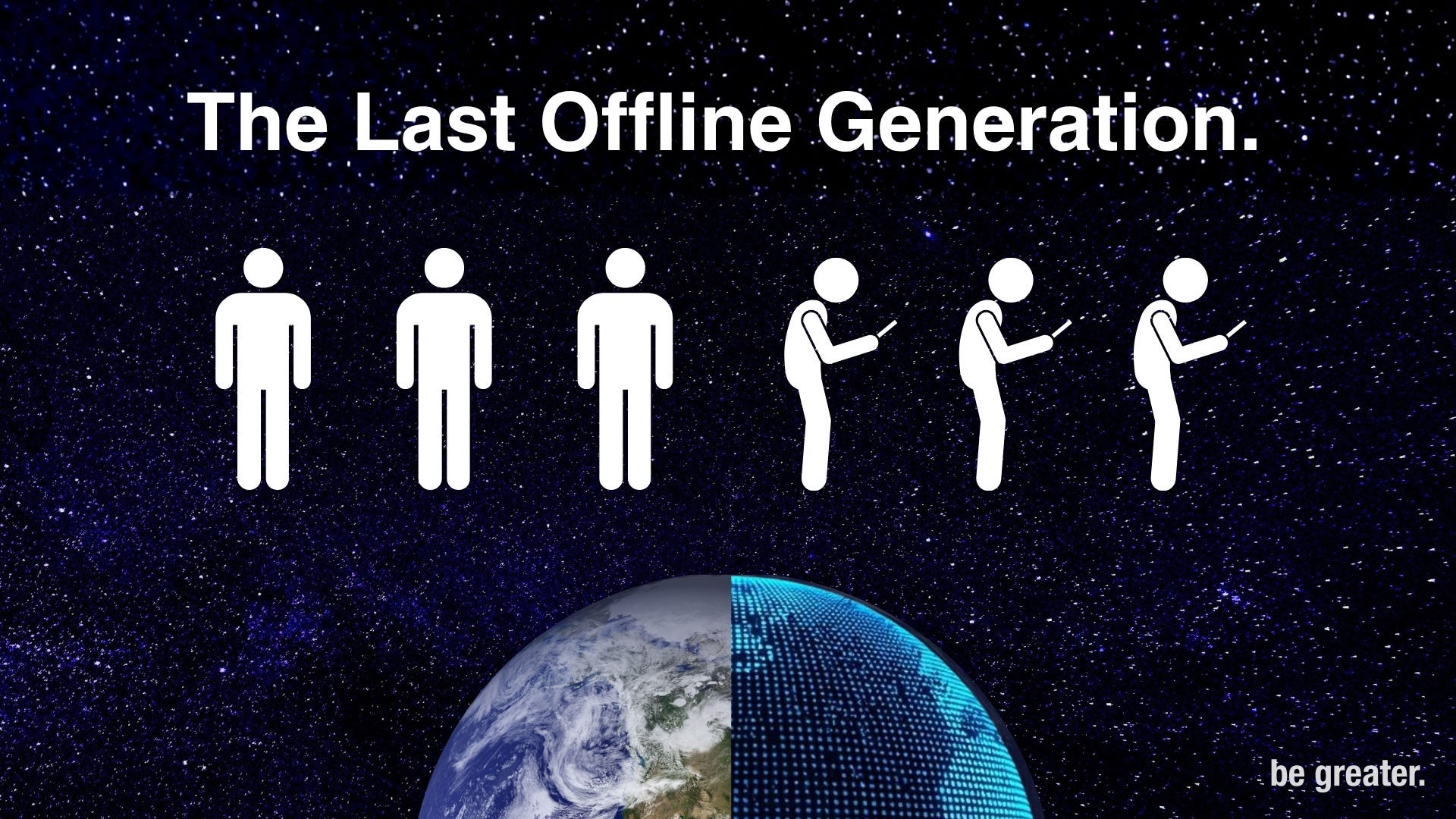
🌎📡 [ begin transmission ] :
Welcome :) You’re reading Be Greater. Thanks for tuning in.
I remember when the internet only existed in one room of the house.
A computer on a desk. Maybe in the office, maybe in a corner of the living room. Or even at a library or computer lab. But it was only accessible from very specific locations.
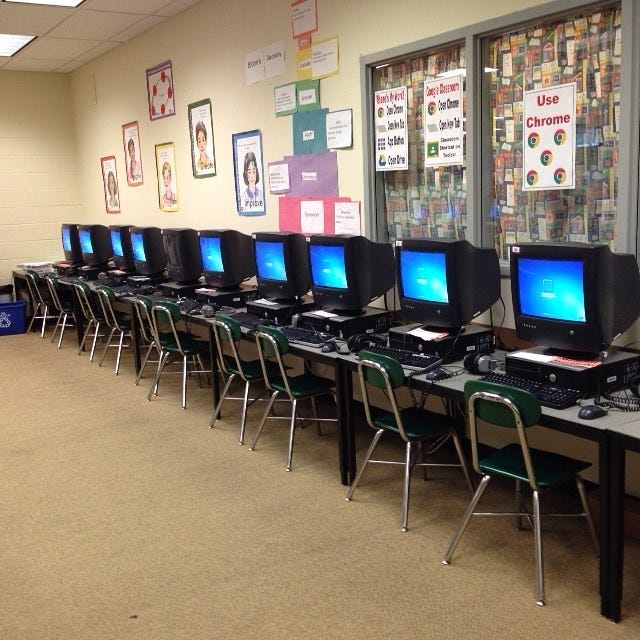
You sat down, you logged on, and you explored for a while. Then when you were done (yes you could actually complete the task of checking the web, there was no infinite scroll), you would log off, stand up, and walk away.
The internet was a place we visited.
It was not a place we lived.
That is not a small distinction.
That is the difference between two completely different ways of being human.
My Generation
I was born in North Carolina, USA, in the year 1999, before the turn of the century. Right before the world worried that the “Y2K computer bug” might crash computer systems and cause global chaos.
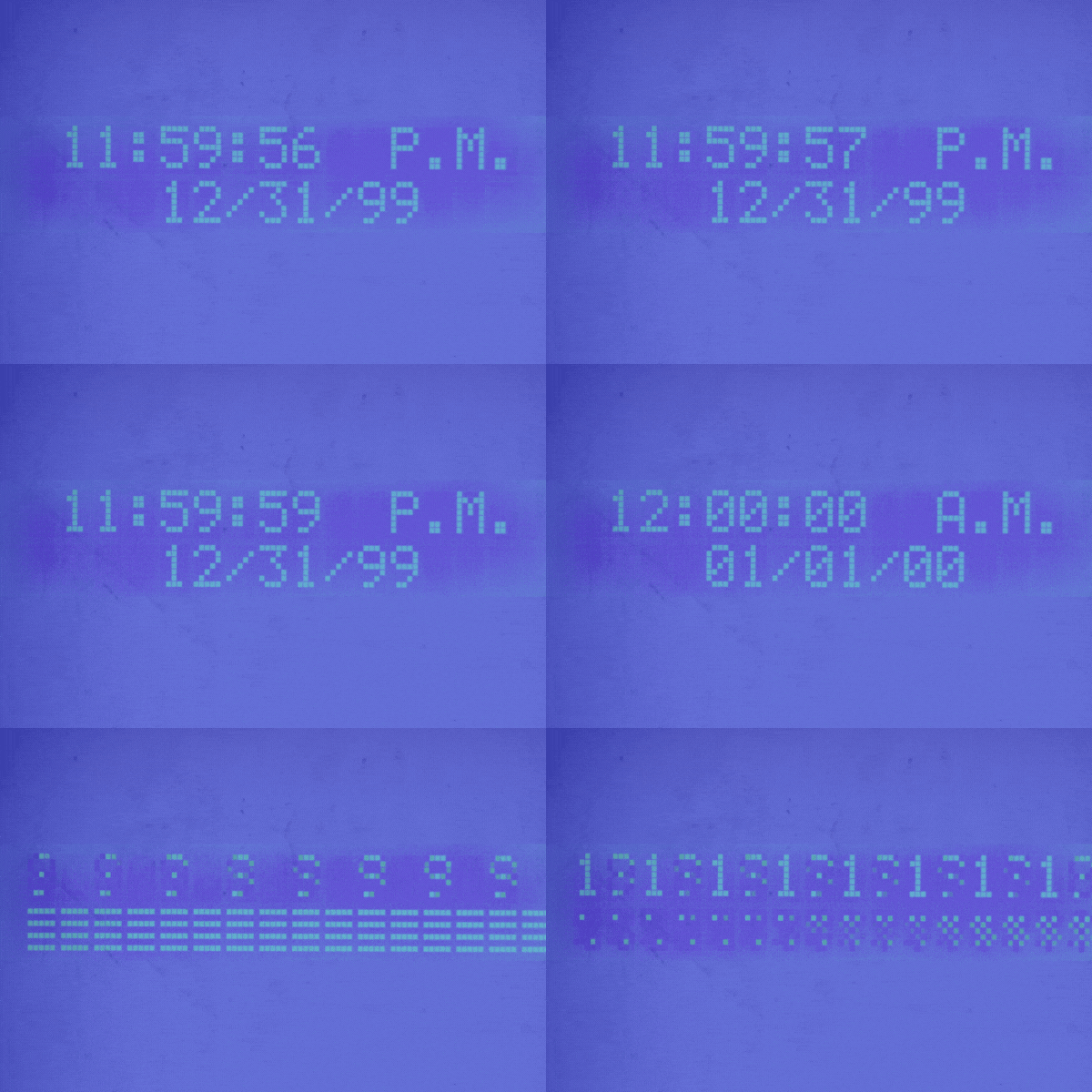
That puts me in a strange little pocket of history — the "Zillennial" micro-generation that emerged between Millennials and Gen Z.
We were alive for 9/11, but too young to really remember it. We learned about it on classroom screens and by hearing teachers retell their experiences of where they were when it happened.
We witnessed Hurricane Katrina,
the financial collapse of 2008,
the golden age of the iPod,
the launch of the iPhone and rise of smartphones,
the political shifts of the 2010s,
the COVID-19 pandemic and worldwide lockdowns of 2020,
and now the rise of AI.
But there's something more significant that makes our generation different from the ones that came before us and the ones that arrived after us:
We were the last ones to experience the offline world.
We are The Last Offline Generation.
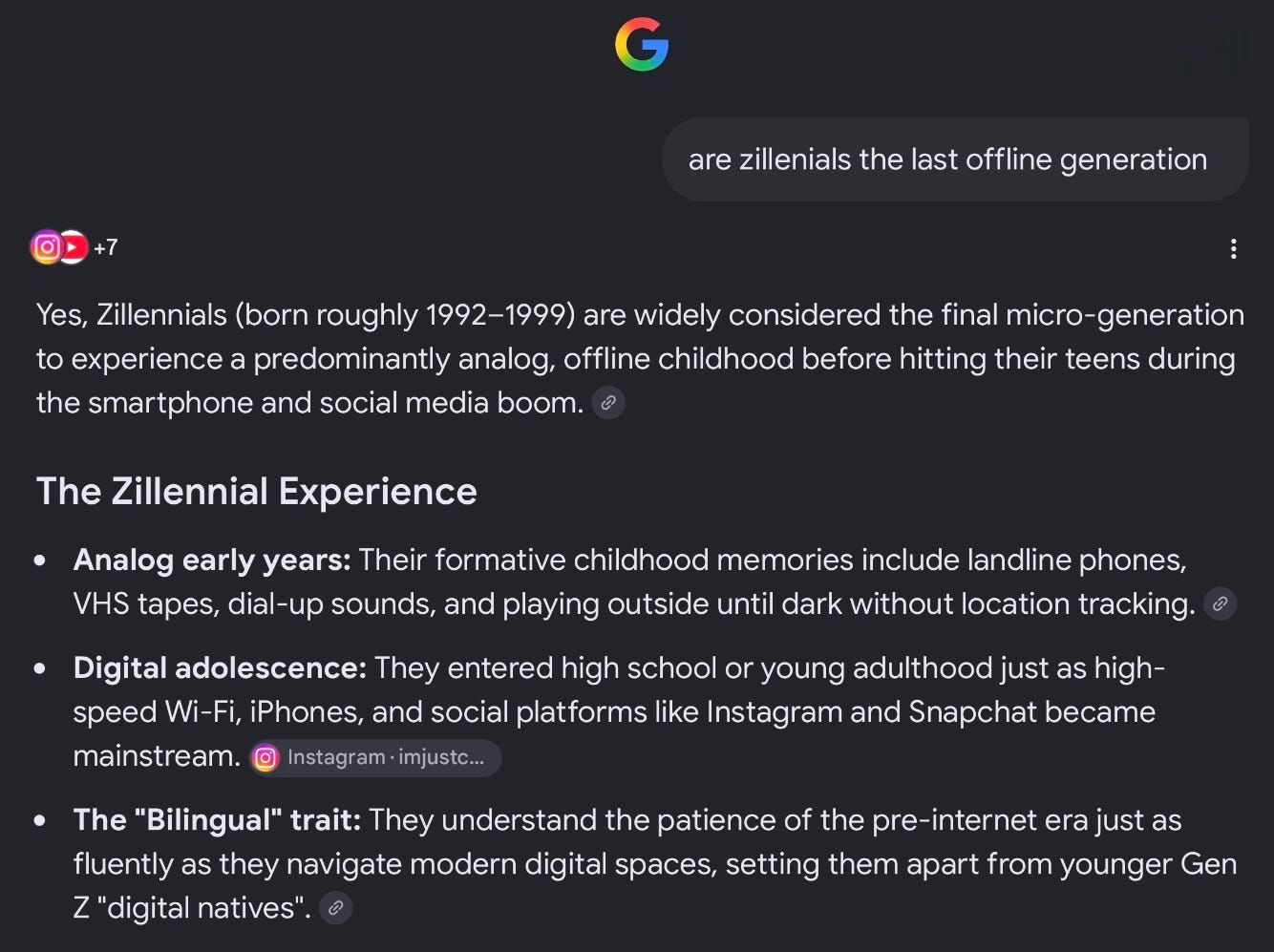
Old enough to remember life before smartphones. Young enough to grow up alongside them. We lived inside both worlds — and watched one become the other in real time.
We had an offline childhood and a digital adolescence.
We didn’t resist the transition. We welcomed it. Of course we did. The online world was exciting, new, and full of possibility. We grew up right alongside it.
It’s only looking back that you realize the door closed behind you.
The Offline World
In the summer, we rode our bikes and skateboards until the streetlights flickered on. We disappeared for hours without a plan, cutting through neighborhoods and woods and creeks.

If our parents needed us, they yelled our names from the porch or drove around hoping to spot us.
There were no phones in our pockets. No location sharing. No group chats asking where we were or when we'd be home. An entire day could pass without a single message, notification, or photograph to prove it had happened.
At the time, it was ordinary. Looking back now, it feels almost impossible.
We had boredom. We had empty afternoons with nothing scheduled. We had to figure out how to entertain ourselves, how to explore, how to meet the neighborhood kids, how to solve problems without Google.
We fell off our skateboards and got back up. We built forts in the woods. We discovered shortcuts through creeks that led to parks we'd only ever reached by car.
The offline world wasn't defined by the absence of technology. We had TVs. Game Boys. Computers. iPods. PlayStation.
The difference was that technology had somewhere to stop. The screen didn't follow you everywhere. It couldn't. You interacted with it, and then you walked away.
It was a tool, not an atmosphere.
In hindsight, we caught an unusually narrow window of human history — the freedom and presence of the offline childhood, plus the creativity and possibility of the early internet, before the algorithms took over and turned everything into a shopping mall.
The Early Internet.
Here is something easy to forget:
The internet used to be fun.
Much more fun and playful than it is now.
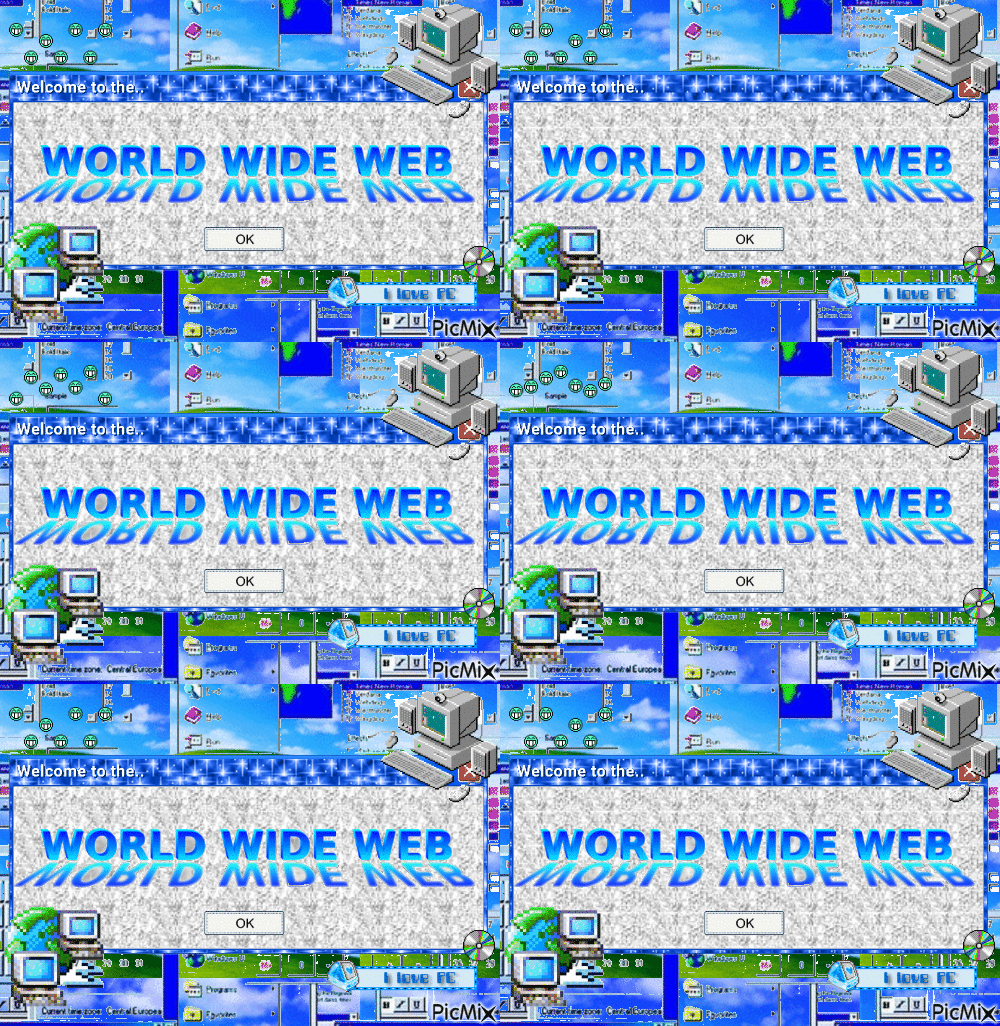
There was MySpace and the sacred Top 8. We lied about our ages (saying we were already 13) to make Facebook profiles and poke our friends. We watched Instagram launch as a simple place for personal square photos. We sent ten-second images on Snapchat that disappeared after you saw them.
None of them had shorts, stories, DMs or most of the features we know now.
Every platform had a unique purpose. A different texture. A different reason to be there.
We had computer lab classes where we learned about this strange new digital space in its earlier days — mastering the internet while it was still young. When you went online, it was the Digital Wild West. Thousands of random little websites, each one a different personality, a different style, a different person’s vision. You could get lost exploring digital jungles that nobody had paved over yet.
And then you logged off. You went back outside. Or at least did something else in the physical offline world.
We saw the internet before it became what it is now.
The Smartphone Inflection Point
In 2007, Steve Jobs stood on a stage and introduced the iPhone.
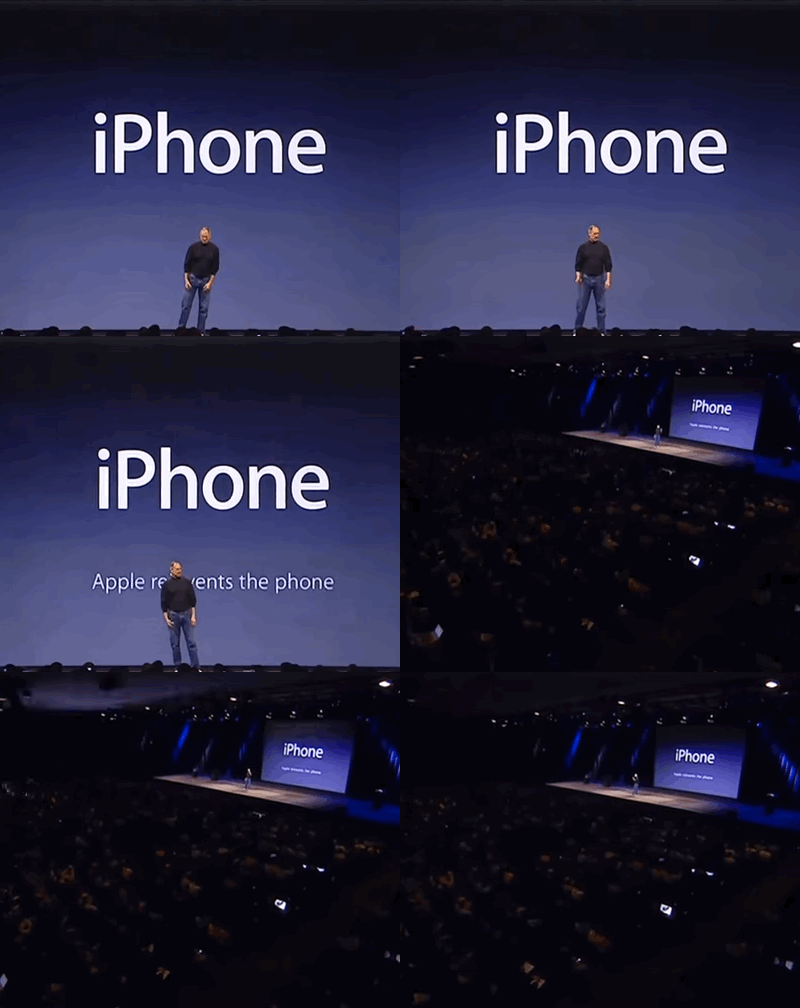
A music player, mobile phone, and computer screen — all in one little device we could carry around in our pockets. The internet was now portable, and it could follow us into every aspect of our lives.
But the world didn't change overnight. The iPhone was just the hinge. The door took a few years to fully swing open. By the early 2010s, smartphones were becoming mainstream.
The internet stopped being a place you visited and became an atmosphere you lived inside.
Before: the internet was a destination.
After: the internet was the environment.
And my generation was right there for all of it. We watched the smartphone transform the world from the ground floor.
We saw it happen in our own backyards. Our own schools. Our own pockets.
And once the internet escaped the confines of computer room, The Online World was able to emerge.
The Online World.
For a while, it was thrilling.
New apps, new communities, new ways to connect and create.
Small creators — artists, writers, YouTubers — were building real audiences from their bedrooms. People were meeting their future partners online.
You could access almost all human knowledge in seconds. You could talk to anyone, anywhere, for free. It felt like pure expansion. Like the world was getting bigger and more connected by the day.
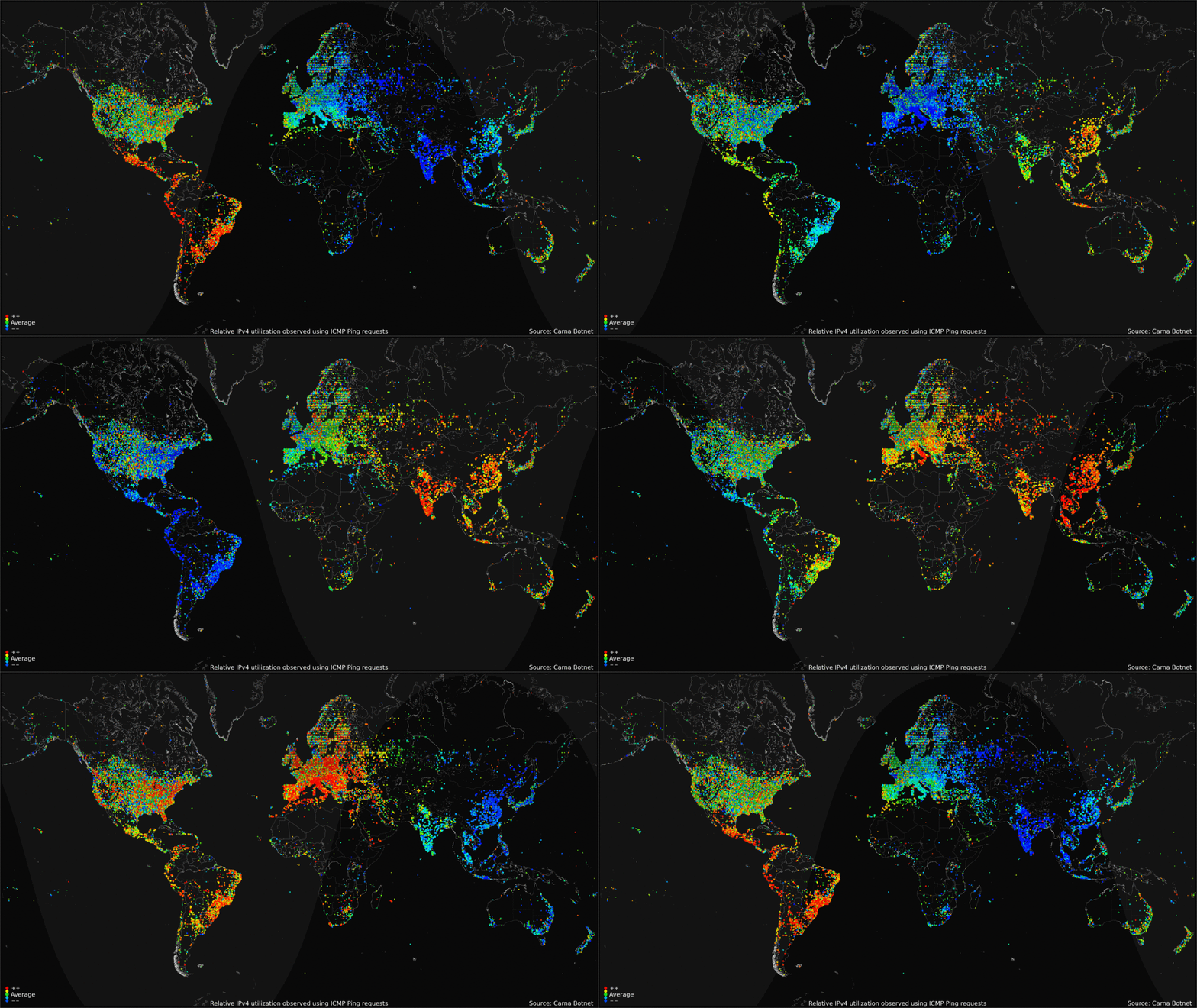
And then, slowly, it wasn't.
The platforms that once felt like playgrounds started feeling like shopping malls.
Every unique space with its unique purpose slowly became just like every other space. They would add Shorts, Stories, Advertisements, Algorithms and even Infinite Scroll. Making their own websites and apps as addicting as possible. Designed to take your time, your attention, and your data — to get you to buy things, to get you to believe things, or just to learn more about you as a potential customer.
There's a word for this now: Enshittification. Things get more corporate. More algorithmic. More branded. The soul drains away. The edges get rounded off. The weird gets smoothed into the safe. The creative becomes the commercial.
We watched the Wild West get settled. The frontiers became franchises. The weird little websites became platforms. The platforms became ecosystems. The ecosystems became machines for harvesting attention.
What used to be vast mysterious digital forests to explore have been paved into something more convenient.
The strange, messy, human thing was paved into something more seamless, simpler, and easier to monetize.
The internet stopped being a place you went to express yourself.
And it became a constant environment that extracts time and information from you.
We Remember Both Worlds
This is the unique position my generation is in.
We didn't read about this shift in a book. We didn't study it from a distance.
We lived inside it. We learned about the internet as it was happening. We had computer classes about it while it was still a new frontier. We grew up alongside it.
We remember the offline world. We remember what it felt like to be unreachable. To be bored. To explore without documenting it. To have a moment that was just yours, shared between friends like a secret, with no audience and no algorithm and no need to perform it for anyone.
And we also remember the early internet. The creativity. The personal expression. The feeling that this was a tool for connection and creation, not extraction and addiction.
So we have something most generations won't: a living before-and-after.
We know what we gained. We know what we lost. And we have the memory of both worlds in our bones.
The Responsibility
You can't fix something you don't understand.
And our generation has an unusually clear vantage point on this shift — because we lived through both sides of it.
That memory is our responsibility.
It means we have a standard to hold. A reference point. A before-and-after that most people don't have. We can't unsee what we saw. We can't forget what it felt like to be unreachable, to be bored, to explore without documenting, to create without optimizing.
The world moved online, and something human got left behind. But we remember what it was. We remember what it felt like.
Maybe our generation's job isn't to tell younger people how great things used to be. Maybe it's to remember what is worth keeping.
To carry the things that matter forward with us into the future.
To hold the higher standard when the world keeps lowering it.
To protect the human things — attention, presence, depth, connection, boredom, creativity — in a world that keeps trying to automate them away.
The Last Offline Generation isn't just a description. It's a job.
We were there when the world went online. We know what we gained. We know what we lost.
And now we have a say in what comes next.
Log off, spread love, be greater.
– [gf]
[ end transmission ] .