

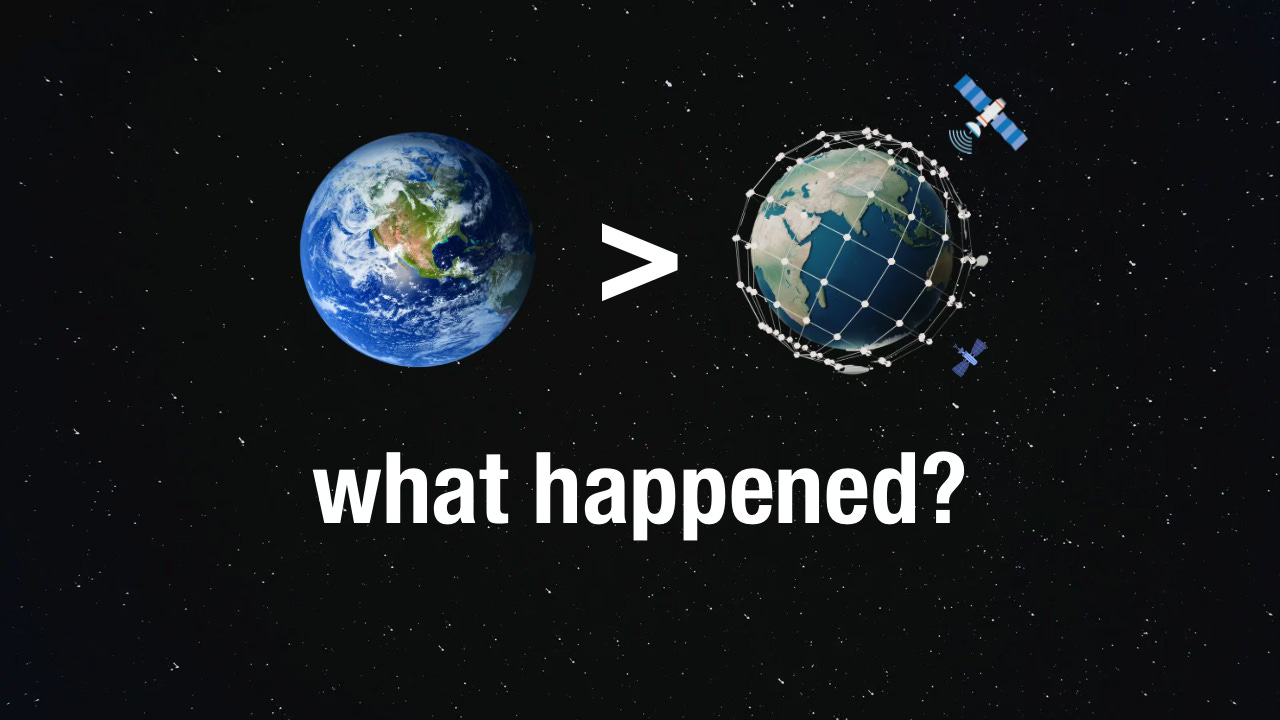
Something feels off in the world. We can sense it, but it’s not so easy to put into words. If you’re reading this the year it was published (2026), then you know exactly what I’m talking about. The vibe has shifted.
1) Culture is feeling more hollow.
Things don’t have staying power, or stand out, or hit the same anymore. Movies, albums, trends, memes. It’s all so fast paced and fragmented into millions of different unique algorithms.
Every once in a while you get an outlier, a cultural event with enough attention to slip into the global mainstream, but even that doesn’t linger the way that it used to. People talk about it for a few days and then move on to something else.
The system moves too fast. The algorithms are optimized to encourage fast-paced, endless, and easily digestible content, but we don’t even digest the content we are consuming. We don’t stop to sit with things, or reflect on them, or analyze them.
And when we do, we look to other people’s comments, other people’s opinions, AI summaries. We are happily giving away our own critical thinking and problem solving skills without giving it a second thought. (The irony hurts.)
But what happens when things get too optimized, and we start smoothing out the texture, the grit, the human, the soul — all the things that make art and content meaningful?
Social media has become more corporate.
The music industry has become more corporate.
The film industry has become more corporate.
The internet, the online world, and in effect culture itself has become corporate — and corporate is not necessarily the birthplace of fresh art and soul. Some might even argue that corporate is where soul goes to die.
Now, the problem with corporate isn’t money or scale — plenty of great art has been made with big budgets. The problem is what happens when the primary goal shifts from making something meaningful to minimizing financial risk. Corporate structures answer to shareholders and quarterly returns, which means they optimize for what’s already proven to work. They greenlight the sequel, the reboot, the familiar face. They A/B test the album covers and sand down anything too weird, too niche, too challenging. The result isn’t inherently bad art — it’s safe art. Competent, focus-grouped, and ultimately forgettable.
Soul requires risk. It requires someone making something that might fail, that not everyone will get, something that exists because someone felt it had to exist, not because a market analysis said it should. That’s harder to do when there are investors to answer to.
Social media used to be a platform for communities and personal connection, but it has devolved into a heavily monetized, brand-driven landscape. Algorithms now prioritize professional content, ads, and influencer marketing over organic and personal posts. This shift has transformed feeds into digital storefronts, and people into brands.
2) Reading and attention spans are in a serious decline.
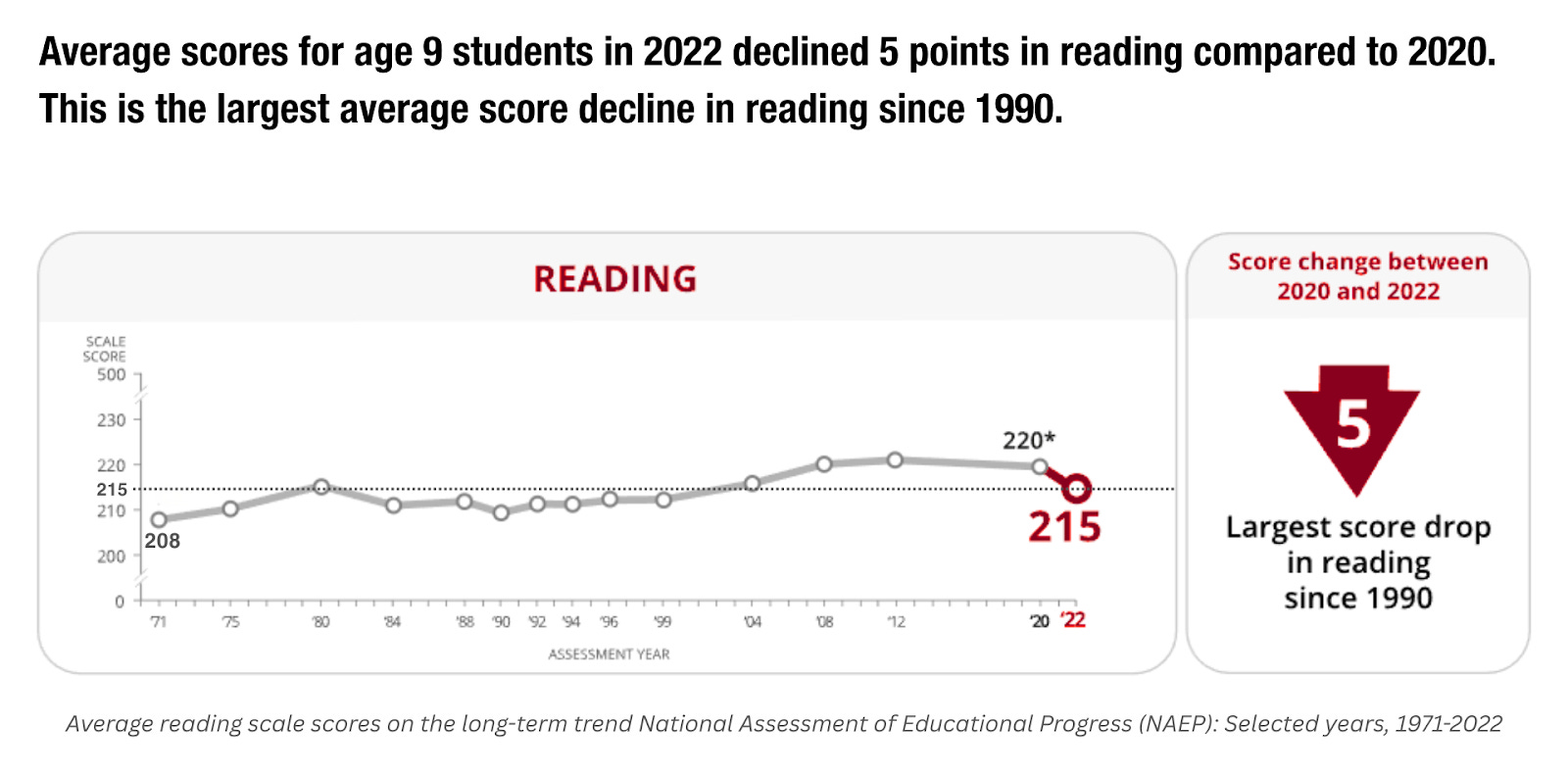
Our reading levels, after reaching record highs in the 2010s, have seemingly fallen back to where they were in ~2004 and ~1980. The gains we have made over recent decades are now quietly slipping away. (1)
Teachers are reporting that students can’t sit with the same material they used to. They can’t focus as long, and they struggle to read the same amount of books and literature that previous generations of students read. Many educators are even having to adapt the course work to be more easily consumable.
That is not the best solution. We can’t just lower the bar so that everyone can step over it. We need to keep holding our standards high and put in the work.
Instead of ignoring the issue, or kicking the responsibility down the road for someone else to deal with, we need to actually take the time to address this problem — that students today can’t complete the same course work as students from previous years. It’s only going to get worse if the next generation of teachers have a more surface level understanding of the course work as well.
To get some personal answers and data on this topic, I conducted interviews with many of my former school teachers, who have worked with students every year across multiple different decades and cultural landscapes.
I figured that out of all the people I could talk to, teachers would have the best vantage point on observing large amounts of students’ behaviors over many different time periods. They have the perfect perspective on whether this is just an internet trend, or if this is the real thing.
Most of the teachers that I interviewed said the same things:
In the last ~10 years:
-Far fewer students are reading for pleasure.
-Students are less focused, have more difficulty completing assigned reading.
-Students appear less mature in the classroom.
-Students are less independent in their classwork, less confident, and asking for constant feedback on their work.
-Students are increasingly on their phones, and are less social than ever. Even when they are together at lunch, they are on their phones, or discussing something they saw on their phones.
And after the COVID-19 Pandemic and the Lockdowns of 2020, these trends only accelerated. (7)
And these same trends are reflected in adults as well. People stopped spending as much time in public or “third” spaces such as coffee shops, parks, malls, bars, etc. Even six years later, recovery has been slow and uneven. Fewer people are hanging out together in the country and in the world.
It doesn’t help that politics are getting more divided and less respectful, cash influences everything, and kids who shouldn’t even know or care about the political landscape yet are being thrown into the deep end and forced to pick sides and learn new terms. It’s all just dystopian to see honestly.
I know boomers and old heads talk about a “better world” back in their day, but recently it seems like there’s finally some truth to that. This goes beyond pure nostalgia or “my generation was better” arguments. This is a documented and observed cultural shift. We can see it happening in real time.
But don’t lose hope yet.
Despite diminishing levels of social engagement and overall trust, most Americans still believe strangers would be willing to help them if they were in trouble, injured, or if their car broke down in public. (4)
And I can agree with this, because recently my car actually did break down and a nice couple helped me push my car out of the main road. We aren’t doomed, we’re just going through a confusing time.
Research generally supports the idea that people with more, or stronger social connections—including more friends—tend to have higher levels of trust in their neighbors and a more positive view of their community and country as a whole. Socially connected individuals are also generally more likely to engage in “neighborly” acts, such as helping with errands or looking after homes. (5,6)
That tells me that the distrust and division going on is a loneliness and isolation problem. We are spending less time together both in the offline and online worlds. But when we actually go out and interact positively with more people, we realize that it’s not so bad.
The problem is that now everyone lives in the online world, and much of that world has shifted from a place of community and connection into a fragmented shopping mall of distraction and division.
And when that happened, our attention also fragmented. Along with our focus, our humor, our politics, our entertainment, and our culture.
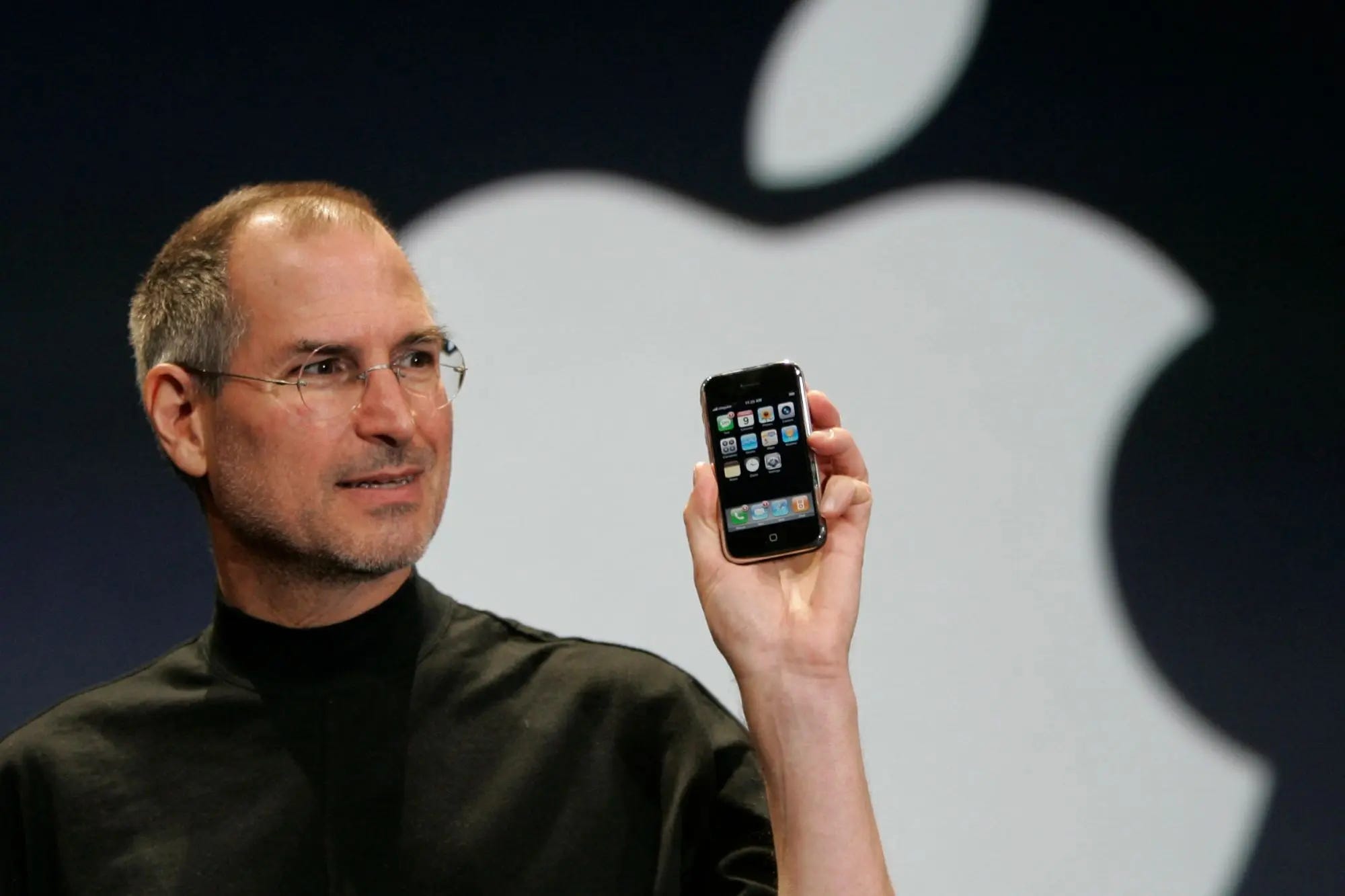
In 2007 Steve Jobs made a “dent in the universe” launching the iPhone as a breakthrough smart device that literally put the internet into your pocket. All of the information on the entire World Wide Web was now in the palm of our hands.
This was an amazing and necessary technological breakthrough, and it was also the start of the online world. The digital world that now expanded beyond our offices and desktops. A world that could now follow us everywhere we go. Now all of a sudden, people had a foot in two worlds, partially online and partially offline.
For a long time this was awesome. There were new apps, new games, new ways to connect, new business opportunities. People were making friends, communities, even meeting their husbands and wives online in different states and countries. Small scale creators: artists, writers, YouTubers were being validated by making careers out of their work. People had new opportunities to work from anywhere in the world.
But like everything eventually does, the online world fell victim to corporate takeover. Longer, more thought out, and more creative videos began being replaced by short-form content, because it’s more engaging, more addicting, and easier to share. It’s the easier content to consume because there’s less thinking and attention span required of you.
Then, as short form began dominating the internet, the pandemic introduced another big turning point. We spent month after month in a state of lockdown, wearing masks, social distancing, isolating from each other.
The lockdowns were exactly what the internet needed to complete its global takeover. When we had nothing going on in the physical world, we all migrated to the online world full-time.
This may have marked the end of the offline world. From that point forward it was clear: Sure, anyone can log off for a while, but it appears the new default state is online.
This is why there are growing trends and counterculture movements showing up online. Digital minimalism, dumb phones, analog technology, music players, eReaders. People tired of consuming who just want to enjoy owning and experiencing things again.
Social interactions, community, ownership, and reading are declining — and along with them: critical thinking, intelligence, empathy. We need an offline / reading movement now more than ever.
This is why I write. Like Steve, I also want to change the world.
I genuinely want to do my part to make it a better place. I want to inspire people to be kinder, be smarter, be more creative, be more open-minded, be greater.
And I think one of the most significant ways to truly change the world is to influence culture.
Artists, authors, creators, messages, and movements can transcend lifetimes. I believe a well crafted message or idea can influence and inspire much more significantly than if I were to attempt to force change through complex, corrupt, and inefficient political systems.
These are my observations, and you are free to disagree, but I am optimistic about the world and the people that live here. I believe we must all be ourselves and use our strengths in the best way possible.
So I choose to write. To get this message out into the world. Maybe it’s largely dismissed, but maybe it changes somebody’s life.
Maybe it even influences culture as a whole.
The world has changed, as it always does. Our culture is constantly evolving, but now we are reaching a new turning point.
We must decide what we want the future to look like. Do we just keep using screens more, and making things more convenient, and spend more time away from each other, and get more divided politically, and stop reading as much, and make school work easier?
Or do we decide to slow down? To stop and think about what we are doing and why. To make sure that we are still innovating, coming up with new ideas, staying open-minded, curious, and disciplined in working toward a better tomorrow for all of us. Do we finally decide that we need to limit spending our entire lives online — endlessly and mindlessly consuming?
We are reaching that point in history, a crucial moment where we decide what comes next, and everything we do, every action we take, is a vote on what we want the world to look like. Just like how every scroll and every click on our screens is a vote for the online world we want to see. We can choose to support quality content, spread knowledge and positivity, and lift each other up instead of tearing each other down.
Because maybe that’s all it takes to start a movement.
In a world where everything is constantly online, things are feeling uncertain, and people are reading less — maybe one kid deciding to become a writer, to become an author, to write a book, to encourage reading, is all it takes to push us in the right direction.
I don’t know if any of this will matter. Maybe this gets lost in the same algorithm I’ve been writing about, but I think about that couple who helped me push my car out of the busy street. They didn’t have to stop. Nobody made them. They just did it because someone needed help and they were there. That impulse — to show up for a stranger, to do the small good thing — hasn’t gone anywhere. It’s just getting harder to see through the noise. So I write. Not because I’m certain it changes anything, but because it’s my version of stopping the car to try and help.
And maybe that’s enough.
- [gf]
*This piece uses ideas, themes, and interviews from my book. If you’re interested in this project, then subscribe to stay updated, and share. You might help me find a publisher.
References:
National Center for Education Statistics. (n.d.). Long-term trends in reading and mathematics achievement. U.S. Department of Education. Retrieved February 12, 2026, from https://nces.ed.gov/fastfacts/display.asp?id=38 (1)
University College London. (2025, August). Proportion of Americans reading for pleasure fell by 40% over 20 years. Retrieved February 12, 2026, from https://www.ucl.ac.uk/news/2025/aug/proportion-americans-reading-pleasure-fell-40-over-20-years (2)
Macdonald, K. T., Barnes, M. A., Miciak, J., Roberts, G., Halverson, K. K., Vaughn, S., & Cirino, P. T. (2021). Sustained attention and behavioral ratings of attention in struggling readers. Scientific studies of reading : the official journal of the Society for the Scientific Study of Reading. https://pmc.ncbi.nlm.nih.gov/articles/PMC8411923/ (3)
Cox, D. A., & Hammond, K. E. (2025). A cultural crossroads: America’s uncertain future amid enduring discontent and rising disconnection. Survey Center on American Life. Retrieved February 12, 2026, from https://www.americansurveycenter.org/research/a-cultural-crossroads-americas-uncertain-future-amidst-enduring-discontent-and-rising-disconnection/ (4)
Martino, J., Pegg, J., & Frates, E. P. (2015, October 7). The connection prescription: Using the power of social interactions and the deep desire for connectedness to empower health and Wellness. American journal of lifestyle medicine. https://pmc.ncbi.nlm.nih.gov/articles/PMC6125010/ (5)
Silver, L. (2025, May 8). How connected do Americans feel to their neighbors?. Pew Research Center. https://www.pewresearch.org/short-reads/2025/05/08/how-connected-do-americans-feel-to-their-neighbors/ (6)
Educator Interviews. Conducted by [garrett fowler], January 2026. (7)
After reading, I scrolled to the bottom expecting to see 100+ likes but what I was met with...
Why is this not viral?!
I appreciate you taking the time to name each issue. I also notice the same issues. The part that also stood out to me was, “The problem is that now everyone lives in the online world, and much of that world has shifted from a place of community and connection into a fragmented shopping mall of distraction and division.” I questioned why behavioral expectations, and now your answers explain it.