

Be Greater. [007]: Do You Still Read?
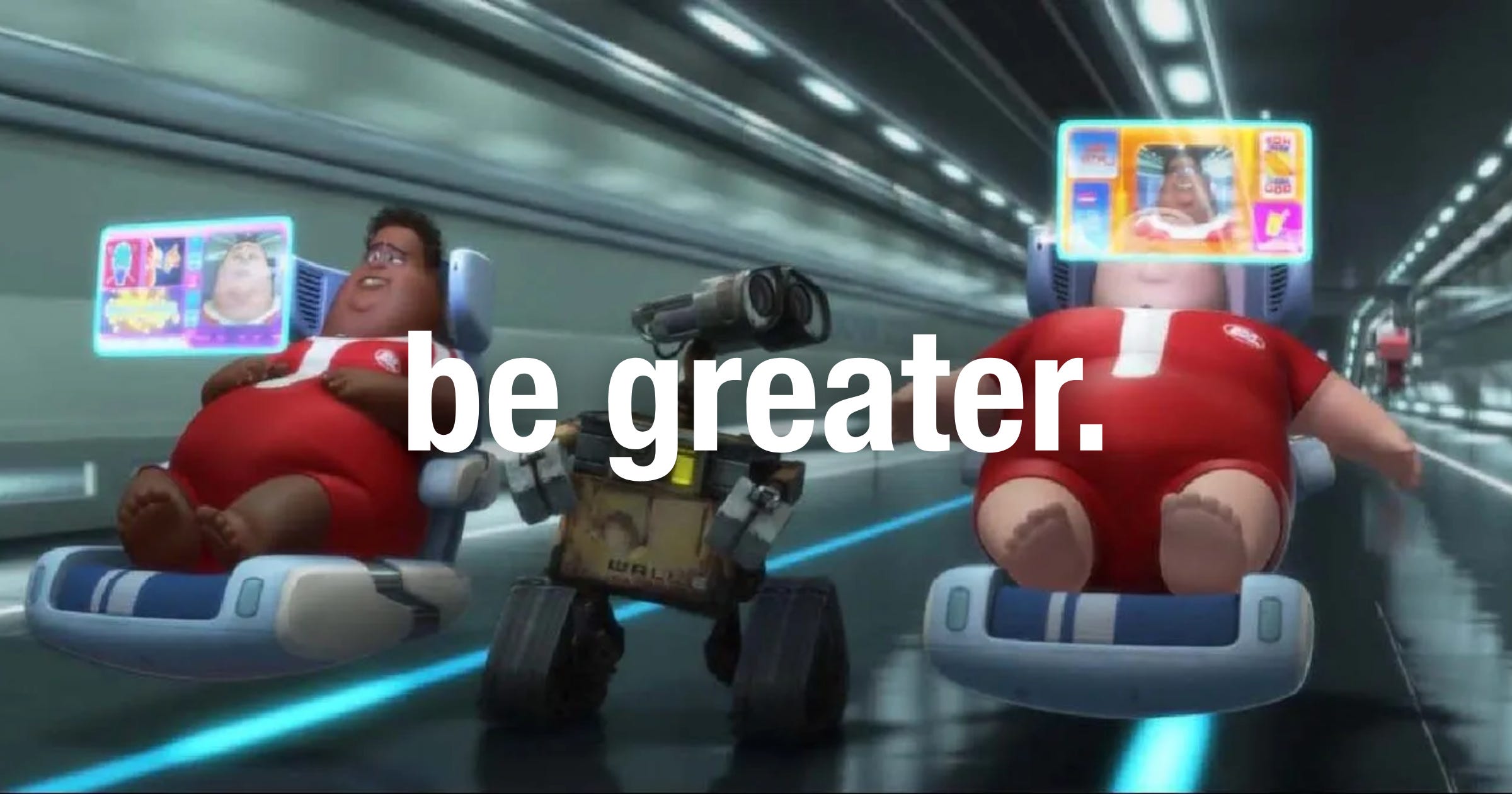
We can’t be a culture that stops reading — or worse, loses the ability to actually read.
![[garrett fowler]'s avatar](https://substackcdn.com/image/fetch/$s_!WxZk!,w_108,h_108,c_fill,f_webp,q_auto:good,fl_progressive:steep/https%3A%2F%2Fsubstack-post-media.s3.amazonaws.com%2Fpublic%2Fimages%2F6ce97a08-7520-465c-b0bd-955824c2756d_640x640.png)
When was the last time you read a book?
Like actually picked out a book for yourself and read the entire thing? Not just a chapter or two — but actually finished a book?
For many of you reading this on Substack that might be a simple question. This is a platform built around reading, and people here tend to read more than most.
But for a lot of people the honest answer sounds more like: “I can’t remember the last book I finished. It’s been years since I read anything for pleasure.”
And for a long stretch after finishing school, that was my answer too.
At some point I realized something strange: I had quietly become a person who didn’t read anymore. And somehow that felt normal. I was still consuming constantly — YouTube, Reddit, social media, documentaries, endless stories and threads of things happening online. It felt like staying informed, keeping up with the world, learning new things.
But it wasn’t really reading. It was scrolling and watching and getting secondhand information. Things pre-filtered through biases, opinions, and narratives that someone else was likely trying to push.
I knew I wasn’t alone in feeling like people weren’t reading much, but I wanted to know how real this shift actually was. So I did a quick web search and found that:
Reading for pleasure has dropped 40 percent in the last twenty years.*
So it’s definitely not just a vibe, or a generational complaint. This is a documented, measured cultural shift happening in real time.
That number sounded drastic — reading decreasing by almost half just since my childhood . But data only goes so far. I wanted to know what this actually looked like in real life, so I reached out to my former teachers to ask if they had noticed the shift.
These are people who have spent decades watching different generations of students learn, focus, and struggle. If anyone would have decent insights into how this shift looked up close, it would be teachers.
And almost all of them described the same shift:
Fewer students reading for pleasure starting in the mid-2010s.
Shorter attention spans, more reliance on shortcuts, less independent thinking.
Post-2020 one teacher said changing activities every ten minutes became necessary just to keep students engaged.
Another said the second there is unstructured time, students reach for their phones — immediately, automatically, without thinking.
Another described students asking for help the moment something gets hard instead of sitting with the discomfort long enough to figure it out.
And one line stood out above everything else:
“Students are becoming consumers instead of producers.”
That’s not just about school. That’s the whole direction culture has been drifting.
The pattern became obvious. Reading lives in unstructured time. Stillness. Quiet. Patience. Those ten seconds of peace and quiet when you can actually think straight and you get to decide what you want to do next.
And those are the exact conditions that modern life keeps eliminating — because every app on your phone, computer, and TV was designed to fill that space and grab your attention before you have time to think about what you should actually be doing with it.
A book doesn’t do that. A book doesn’t fight for your attention, notify you, or force its way into your life. It just sits there quietly, patiently, waiting for a curious mind to pick it up.
The bigger realization for me wasn’t just that I had stopped reading. It was that I had been adapting to a world designed to replace it. I was embracing the new normal — a world of distractions and consumption — without even questioning it.
So I decided to change that. I decided to start reading again.
I started small. A few pages at a time. Some nights just one or two. But a few pages was better than scrolling another evening away. At least now I was completing something. Learning something. Making actual progress instead of just consuming endless content.
I started out with physical books. Then I got an E-Reader: a Kindle Basic — no internet, no notifications, no algorithm. Just books I had chosen and downloaded, sitting on a paper ink screen. Intentional technology. Technology that benefitted me instead of taking away from me.
Then I did something that really helped me get into this new reading habit: I downloaded the Kindle app on my phone and synced all the books in my library. Then I deleted or blocked any social media and other distracting, time-wasting apps from my phone. Now whenever I pick up my phone, it shows me my current book on the lockscreen, and then again on the home screen.
My only choices became: text someone, take down a note, set a reminder, write something, or keep reading my current book. The same device I used to scroll Reddit and watch YouTube on — but now I was flipping pages of a book. Slowly the old scrolling habits got replaced. When I was bored, I started reaching for a book or even checking my to-do list instead of procrastinating.
I carried the same device around, but now I had a completely different relationship with it. My environment was now set up to guide me toward what I actually wanted instead of pulling me away from it.
That’s something we aren’t talking about enough:
The default settings on our devices are not built to serve our wellbeing.
They are built to maximize engagement. If you use the defaults, you will default into distraction. You have to design your own environment intentionally — make the thing you want to do easier to reach than the things that are trying to capture your attention.
After changing my environment and, in turn, my habits, I started to notice subtle changes. My attention and focus had honestly improved. I felt more patient. I remembered what it felt like to stay with something all the way to the end — and how different that feels compared to finishing a session of scrolling.
One teacher said something near the end of our conversations that stayed with me. She said students today are more capable than they believe themselves to be. They give up quickly not because they can’t do hard things, but because they’ve never had to practice not giving up. They’ve never sat with a difficult problem long enough to discover they could solve it — so they don’t trust themselves to.
I think that really applies to all of us these days.
Reading isn’t just about becoming smarter or looking intellectual. It’s about reclaiming something that quietly slipped away. Your attention. Your patience. Your ability to sit with a hard idea long enough for it to actually become yours — not summarized, not explained by someone else, not processed through an algorithm, but your own.
A book asks something from you that the modern world rarely does.
Stillness. Effort. Presence.
And in a world designed to replace all three of those things, choosing to read might be one of the most quietly radical acts left.
We simply can’t afford to become a culture that doesn’t read. Or worse — a culture that can’t read. It feels like we’re getting dangerously close.
The only way back is one page at a time.
So if you aren’t already — start reading books. Fiction, non-fiction, doesn’t matter. Pick something cool and get started.
Don’t be lazy. Every page you turn is a vote for a better version of yourself, and eventually a better world. If we want our culture to be greater, we have to build greater habits.
Read more. Think for yourself. Own your mind.
Thanks for reading B)
Log off, spread love, be greater.
— [gf]
Sources:
https://news.ufl.edu/2025/08/reading-for-pleasure-study/ (*)